Sitting Down with Mint to Talk the Housing Crisis in Canada

As housing affordability continues to challenge communities across Canada, modular construction is emerging as a key solution. In this conversation, a representative from Mint Tiny House Company shares how their modular homes are addressing the urgent need for fast, cost-effective housing — particularly in high-demand areas like British Columbia. 

From quick factory turnaround to sustainable infill strategies, this interview explores how Mint is contributing to Canada’s housing goals with quality, efficiency, and purpose.

Mint Modular: Helping to Tackle the Canadian Housing Crisis


Interviewer: 

To start, could you give us an overview of how Mint Tiny House Company is positioned to address the growing demand for modular housing in British Columbia and Canada?

Mint:

“That’s a great question. We are seeing an increased awareness and need for modular housing as municipalities and cities are under pressure to achieve their housing targets. Plus most areas around major cities have become incredibly expensive making it almost impossible for most people to become homeowners. Modular homes can offer an affordable and predictable alternative in a market where that’s hard to come by. 

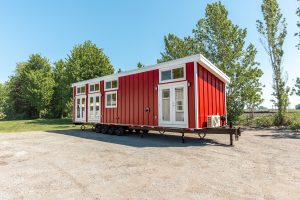
Mint has two core strengths: speed and cost. We can help address this growing demand because of how fast we can build a house. Our factory builds eight homes at a time and our production line can produce a house in six to eight weeks, which means there’s a completed and fully liveable house coming out of our factory every three to five days. This can really help municipalities and cities that are looking to have an immediate impact in terms of executed, affordable housing. 

We also have houses that start at $176k and our highest priced home is $220k. Our pricing is fixed as well – the day the contract is signed there will not be any price creep for the customer. This is a stark contrast to what happens with traditionally built homes. Our value proposition in high-cost areas like Greater Vancouver (or any other major metropolitan area) is extremely attractive to private landowners as well as developers.  Mint modular homes fall well under the new $1M price point for Mark Carney’s proposed Tax Incentives which means significant costs savings for first-time buyers. 

Quick Turnarounds Benefit Everyone

Interviewer:

That’s impressive. Given that quick turnaround, how do you see modular housing addressing some of the key challenges that municipalities face, such as Mark Carneys goal of doubling the housing construction and achieving 500k new homes?

Mint:

“When we look at the problem at hand, which we know is the affordability and housing crisis across Canada, we need to really look to modular homes to provide that affordable and timely solution. Our modular homes don’t require any on-site construction. All the construction is done in our factory. The homeowner essentially places their order, gets their site ready for the install and then waits for the house to be delivered. The timeline is fixed. It’s guaranteed to be within a week of the selected completion date. Once the site services are ready, the house can be connected to the site within 24 hours, and with all our modular homes somebody is moving into the house the day that it’s dropped on the property. So it’s very quick. 

We also have consistent house plans (we are not submitting different plans every time) which, once they are approved by a city, can easily be approved again. 

So steady, dependable production of affordable, new, high-quality homes is part of the path forward to achieving 500k homes.”

Contributing to the Broader Community Development

Interviewer:

That makes a lot of sense. With that level of efficiency and predictability, how do you see Mint’s modular homes contributing to broader community development and sustainability goals over the next few years?

Mint:

“Great question again. So one path to sustainability comes from not expanding our footprint with sprawling communities. If you look at the Greater Vancouver and surrounding areas, there are thousands of large lots that can accommodate the addition of a smaller home on the back of the property and the recently enacted Bill 44 helps pave the way for homeowners to achieve this. This concept does not require new land – it is re-purposing existing land. 

The benefit is two-fold – the modular home can either be a rental – thus adding to the rental market or it can house a family member. Either way, you’re providing more housing for rental purposes, either by freeing up housing or creating new housing. There are generations that are now facing the reality of either never owning their own home or never having their kids move out. With our current housing demands the ability to place a smaller unit on the back of a homeowner’s property would allow them to have either their children or an elderly parent live on the same property but not in the same home. Or they can be earning rental income from the unit. 

Our modular homes provide these solutions in weeks. Not months or years but weeks. So again, instead of looking for sprawl, instead of trying to find land, the land already exists and can be used for single or multiple dwellings. Instead of spending a year in prolonged construction families can make a significant and positive change to their lives in a short period of time. This approach also helps build communities around existing services.”

Mint, Helping to Address Housing Shortages

Interviewer:

It sounds like Mint is really positioned to support sustainable growth while addressing housing shortages. One final question: what do you think are the biggest misconceptions about modular homes, and how is Mint working to change those perceptions?

Mint:

“Yeah, the common misperception on modular home is that it’s an inferior product. That they are not quality homes. This obviously stems from the stigma that remains from the 70s when mobile homes were considered the same thing as a modular home. But the modular industry has come a long way and in many ways are leaders in housing production. 

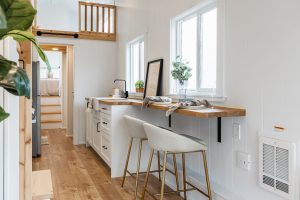
To be very frank, our homes are built to the same level and building code that any new tilt-up or lumber construction home would be. So the quality is higher than it has ever been. You also have efficiencies built into modular homes that never existed even a decade ago. Because these are much smaller homes, they require far less energy. 

They are incredibly well insulated and incredibly efficient in terms of keeping heat in and cold out compared to the mobile homes of the distant past. There are also different variations of modular homes. Modular can mean that it is built in sections within a controlled factory and then assembled on site – so there are still weeks of construction at the site. 

Mint is different in that we produce the entire house in our factory and ship it completed to the site. Our team is highly skilled and passionate about building the best quality homes we can. 

Another misconception is cost. In the past the selling feature on modular homes was the low price. But that is also were the low-quality perception came from too. 

Current modular homes provide great value but are not cheap.  We recognize that value is subject to geography (location). One of our homes might be more expensive when compared to what you could purchase in the middle of the country. But in terms of what you would find in Vancouver or the lower mainland, once you include all permitting costs, sites services and all the connections tied in, you’re going to be in the $275,000 price range, which is something that just doesn’t exist in the current market. You can’t buy anything new like that. 

Interviewer:

That’s a solid explanation of how modular homes have evolved and the benefits they offer today. Thanks so much! 

Related Articles

Park Model | Gallery.
Blog Posts

9 Reasons a Tiny House Makes an Excellent Investment!

Discover why Mint tiny homes are ideal investments! Prefabrication keeps costs down, and tiny homes offer easy market flexibility. Plus, they add value to existing rentals and can be sold separately from land. Repurposing, the real tiny house hype, lower maintenance costs, high bed ratio, and competitive rental rates make them lucrative.

Read More »

CONTACT US